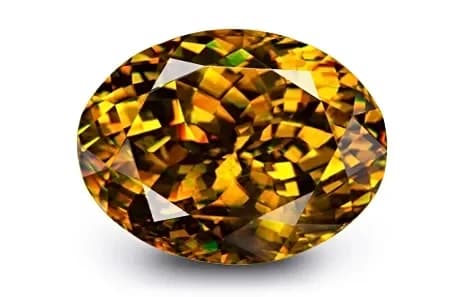
Titanite
Titanite, also known as Sphene, is prized for exceptional dispersion, vivid color, and brilliant flashes of fire, making it a distinctive choice for collectors and jewelry lovers.
Titanite, commonly known as Sphene in the gemstone and jewelry trade, is a calcium titanium nesosilicate mineral with the chemical formula CaTiSiO5. It belongs to the titanite mineral group and crystallizes in the monoclinic crystal system, commonly forming distinctive wedge-shaped crystals. The name Titanite refers to its titanium content, while Sphene comes from the Greek word sphenos, meaning wedge. In 1982, the International Mineralogical Association adopted Titanite as the official mineral name, although Sphene remains widely used in gem and jewelry markets. Titanite is best known for its exceptionally strong dispersion, which can produce vivid spectral flashes or 'fire' that are especially noticeable in well-cut transparent stones. Its refractive index ranges from 1.843 to 2.110 and its specific gravity is approximately 3.4-3.6. With a Mohs hardness of 5-5.5 and good cleavage, Titanite is relatively soft and brittle compared with many traditional jewelry gemstones, so it requires thoughtful cutting and careful wear. Titanite occurs in yellow, green, brown, orange, red, gray, black, and near-colorless varieties, although yellow, green, yellowish-green, and brown tones are particularly characteristic of gem-quality material. Strong pleochroism can produce different apparent colors when a transparent stone is viewed from different directions. Green material may owe its color to chromium or iron, while other trace elements can influence the final bodycolor. Titanite forms in a range of geological environments, including igneous and metamorphic rocks, and gem-quality crystals are uncommon compared with the widespread occurrence of the mineral itself. Important gem-quality localities include Madagascar, Brazil, Mexico, Pakistan, Switzerland, and other regions. The Smithsonian National Museum of Natural History holds a notable 43.52-carat Madagascar Titanite specimen, demonstrating the impressive size and color that collector-grade material can achieve. Historically, Titanite has been valued by mineral collectors because of its attractive crystal forms, luster, strong dispersion, and unusual optical character. In modern jewelry, transparent Titanite is usually fashioned into carefully protected rings for occasional wear, earrings, pendants, and other pieces where the stone is less exposed to abrasion or impact. Buyers value natural Titanite for its distinctive combination of high refractive index, strong fire, vivid colors, pleochroism, and relative rarity as a transparent faceted gemstone. For anyone considering natural Titanite online, the stone's durability, clarity, cut quality, color, and documented identity should be considered together rather than focusing on size alone.
- Mineral Family
- Titanite
- Chemical Formula
- CaTiSiO5
- Mohs Hardness
- 5 - 5.5
- Refractive Index
- 1.843 - 2.110
- Specific Gravity
- 3.4 - 3.6
- Cleavage
- Good
- Crystal System
- Monoclinic
- Luster
- Adamantine
- Color Range
- Yellow, Green, Orange, Red, Black, Gray, White
When buying Titanite gemstone, evaluate the stone as a combination of color, clarity, cut, carat weight, origin, treatment status, and documentation. Color: Vivid green, yellow-green, yellow, and attractive orange or red tones can be especially appealing. Look for a lively bodycolor that works well with the stone's strong dispersion. Green Titanite may be particularly desirable when the color is saturated and evenly distributed. Clarity: Transparent Titanite is the material most suitable for faceting. Minor inclusions may be acceptable in a rare gemstone, but fractures, large cavities, or inclusions that noticeably reduce transparency can affect beauty and durability. Because Titanite has strong optical effects, inspect the stone from multiple angles rather than judging clarity only from the face-up view. Cut: Cut quality is critical because Titanite's high dispersion is one of its defining attractions. A well-proportioned cut can maximize brilliance and spectral fire, while poor orientation or windowing can make the stone appear dull. Faceting should also take its cleavage and brittleness into account. Carat: Larger clean, well-colored faceted Titanite can be considerably rarer than small commercial material, but carat weight should never be considered separately from clarity, color, cut, and transparency. Origin: Gem-quality Titanite is associated with localities including Madagascar, Brazil, Mexico, Pakistan, Switzerland, and other regions. Origin can contribute to collector interest and value, but it should be supported by credible evidence when an origin premium is claimed. Treatments: Most Titanite is sold untreated, but heat treatment has been reported as a way to alter brownish material toward red or orange tones. Buyers should ask whether a stone has been heated and ensure any disclosed treatment is clearly stated on the listing or laboratory report. Natural vs lab-grown: Natural Titanite is the established material in the gemstone market. Do not assume that a seller's use of terms such as 'natural,' 'genuine,' or 'untreated' is sufficient proof of identity. If a laboratory-grown material or imitation is offered, it should be clearly disclosed as such. Certification: For valuable or unusual stones, an independent gemological report can confirm the gemstone identity and document relevant characteristics or treatments. Check the laboratory name, report number, stone description, weight, measurements, and identification details, and verify the report directly with the issuing laboratory where possible. Authenticity: A credible seller should provide clear photographs, accurate measurements, treatment disclosure, and consistent product information. For higher-value Titanite, independent laboratory identification is the safest way to confirm that the material is actually Titanite rather than a visually similar stone. Price factors: Titanite value is influenced by color, transparency, clarity, cut quality, dispersion and visible fire, carat weight, treatment status, origin when documented, and the quality of the laboratory documentation. Since Titanite is relatively soft and has good cleavage, exceptionally large or highly clean faceted stones may command collector interest. When you buy Titanite online, prioritize transparent disclosure and gemological evidence over exaggerated claims about rarity or performance.
Titanite requires more careful handling than harder gemstones because its Mohs hardness is only 5-5.5 and it has good cleavage. Cleaning: Use lukewarm water, a small amount of mild soap, and a soft brush or lint-free cloth. Rinse carefully and dry with a soft cloth. Avoid ultrasonic and steam cleaners unless a qualified professional has confirmed that the particular stone is suitable for them. Storage: Store Titanite separately from harder gemstones such as diamond, sapphire, ruby, and topaz because those materials can scratch its surface. A soft jewelry pouch or individual compartment is ideal. Everyday wear: Titanite is better suited to earrings, pendants, brooches, and occasional-wear rings than to jewelry exposed to constant abrasion. If worn in a ring, a protective setting and careful handling can reduce the chance of damage. Things to avoid: Avoid sharp impacts, rough activities, prolonged exposure to harsh chemicals, sudden temperature changes, and abrasive cleaning materials. Pay particular attention to the stone's cleavage when wearing or setting it. If a Titanite gemstone becomes loose, chipped, or visibly damaged, have it inspected by a qualified jeweler before continued wear.
Titanite, commonly known as Sphene in the gemstone and jewelry trade, is a calcium titanium nesosilicate mineral with the chemical formula CaTiSiO5. It belongs to the titanite mineral group and crystallizes in the monoclinic crystal system, commonly forming distinctive wedge-shaped crystals. The name Titanite refers to its titanium content, while Sphene comes from the Greek word sphenos, meaning wedge. In 1982, the International Mineralogical Association adopted Titanite as the official mineral name, although Sphene remains widely used in gem and jewelry markets. Titanite is best known for its exceptionally strong dispersion, which can produce vivid spectral flashes or 'fire' that are especially noticeable in well-cut transparent stones. Its refractive index ranges from 1.843 to 2.110 and its specific gravity is approximately 3.4-3.6. With a Mohs hardness of 5-5.5 and good cleavage, Titanite is relatively soft and brittle compared with many traditional jewelry gemstones, so it requires thoughtful cutting and careful wear. Titanite occurs in yellow, green, brown, orange, red, gray, black, and near-colorless varieties, although yellow, green, yellowish-green, and brown tones are particularly characteristic of gem-quality material. Strong pleochroism can produce different apparent colors when a transparent stone is viewed from different directions. Green material may owe its color to chromium or iron, while other trace elements can influence the final bodycolor. Titanite forms in a range of geological environments, including igneous and metamorphic rocks, and gem-quality crystals are uncommon compared with the widespread occurrence of the mineral itself. Important gem-quality localities include Madagascar, Brazil, Mexico, Pakistan, Switzerland, and other regions. The Smithsonian National Museum of Natural History holds a notable 43.52-carat Madagascar Titanite specimen, demonstrating the impressive size and color that collector-grade material can achieve. Historically, Titanite has been valued by mineral collectors because of its attractive crystal forms, luster, strong dispersion, and unusual optical character. In modern jewelry, transparent Titanite is usually fashioned into carefully protected rings for occasional wear, earrings, pendants, and other pieces where the stone is less exposed to abrasion or impact. Buyers value natural Titanite for its distinctive combination of high refractive index, strong fire, vivid colors, pleochroism, and relative rarity as a transparent faceted gemstone. For anyone considering natural Titanite online, the stone's durability, clarity, cut quality, color, and documented identity should be considered together rather than focusing on size alone.
- Mineral Family
- Titanite
- Chemical Formula
- CaTiSiO5
- Mohs Hardness
- 5 - 5.5
- Refractive Index
- 1.843 - 2.110
- Specific Gravity
- 3.4 - 3.6
- Cleavage
- Good
- Crystal System
- Monoclinic
- Luster
- Adamantine
- Color Range
- Yellow, Green, Orange, Red, Black, Gray, White
When buying Titanite gemstone, evaluate the stone as a combination of color, clarity, cut, carat weight, origin, treatment status, and documentation. Color: Vivid green, yellow-green, yellow, and attractive orange or red tones can be especially appealing. Look for a lively bodycolor that works well with the stone's strong dispersion. Green Titanite may be particularly desirable when the color is saturated and evenly distributed. Clarity: Transparent Titanite is the material most suitable for faceting. Minor inclusions may be acceptable in a rare gemstone, but fractures, large cavities, or inclusions that noticeably reduce transparency can affect beauty and durability. Because Titanite has strong optical effects, inspect the stone from multiple angles rather than judging clarity only from the face-up view. Cut: Cut quality is critical because Titanite's high dispersion is one of its defining attractions. A well-proportioned cut can maximize brilliance and spectral fire, while poor orientation or windowing can make the stone appear dull. Faceting should also take its cleavage and brittleness into account. Carat: Larger clean, well-colored faceted Titanite can be considerably rarer than small commercial material, but carat weight should never be considered separately from clarity, color, cut, and transparency. Origin: Gem-quality Titanite is associated with localities including Madagascar, Brazil, Mexico, Pakistan, Switzerland, and other regions. Origin can contribute to collector interest and value, but it should be supported by credible evidence when an origin premium is claimed. Treatments: Most Titanite is sold untreated, but heat treatment has been reported as a way to alter brownish material toward red or orange tones. Buyers should ask whether a stone has been heated and ensure any disclosed treatment is clearly stated on the listing or laboratory report. Natural vs lab-grown: Natural Titanite is the established material in the gemstone market. Do not assume that a seller's use of terms such as 'natural,' 'genuine,' or 'untreated' is sufficient proof of identity. If a laboratory-grown material or imitation is offered, it should be clearly disclosed as such. Certification: For valuable or unusual stones, an independent gemological report can confirm the gemstone identity and document relevant characteristics or treatments. Check the laboratory name, report number, stone description, weight, measurements, and identification details, and verify the report directly with the issuing laboratory where possible. Authenticity: A credible seller should provide clear photographs, accurate measurements, treatment disclosure, and consistent product information. For higher-value Titanite, independent laboratory identification is the safest way to confirm that the material is actually Titanite rather than a visually similar stone. Price factors: Titanite value is influenced by color, transparency, clarity, cut quality, dispersion and visible fire, carat weight, treatment status, origin when documented, and the quality of the laboratory documentation. Since Titanite is relatively soft and has good cleavage, exceptionally large or highly clean faceted stones may command collector interest. When you buy Titanite online, prioritize transparent disclosure and gemological evidence over exaggerated claims about rarity or performance.
Titanite requires more careful handling than harder gemstones because its Mohs hardness is only 5-5.5 and it has good cleavage. Cleaning: Use lukewarm water, a small amount of mild soap, and a soft brush or lint-free cloth. Rinse carefully and dry with a soft cloth. Avoid ultrasonic and steam cleaners unless a qualified professional has confirmed that the particular stone is suitable for them. Storage: Store Titanite separately from harder gemstones such as diamond, sapphire, ruby, and topaz because those materials can scratch its surface. A soft jewelry pouch or individual compartment is ideal. Everyday wear: Titanite is better suited to earrings, pendants, brooches, and occasional-wear rings than to jewelry exposed to constant abrasion. If worn in a ring, a protective setting and careful handling can reduce the chance of damage. Things to avoid: Avoid sharp impacts, rough activities, prolonged exposure to harsh chemicals, sudden temperature changes, and abrasive cleaning materials. Pay particular attention to the stone's cleavage when wearing or setting it. If a Titanite gemstone becomes loose, chipped, or visibly damaged, have it inspected by a qualified jeweler before continued wear.
Titanite for Sale
No gems found
Try broadening your search or adjusting your filters.
Have a gem of your own? List it free - no fees