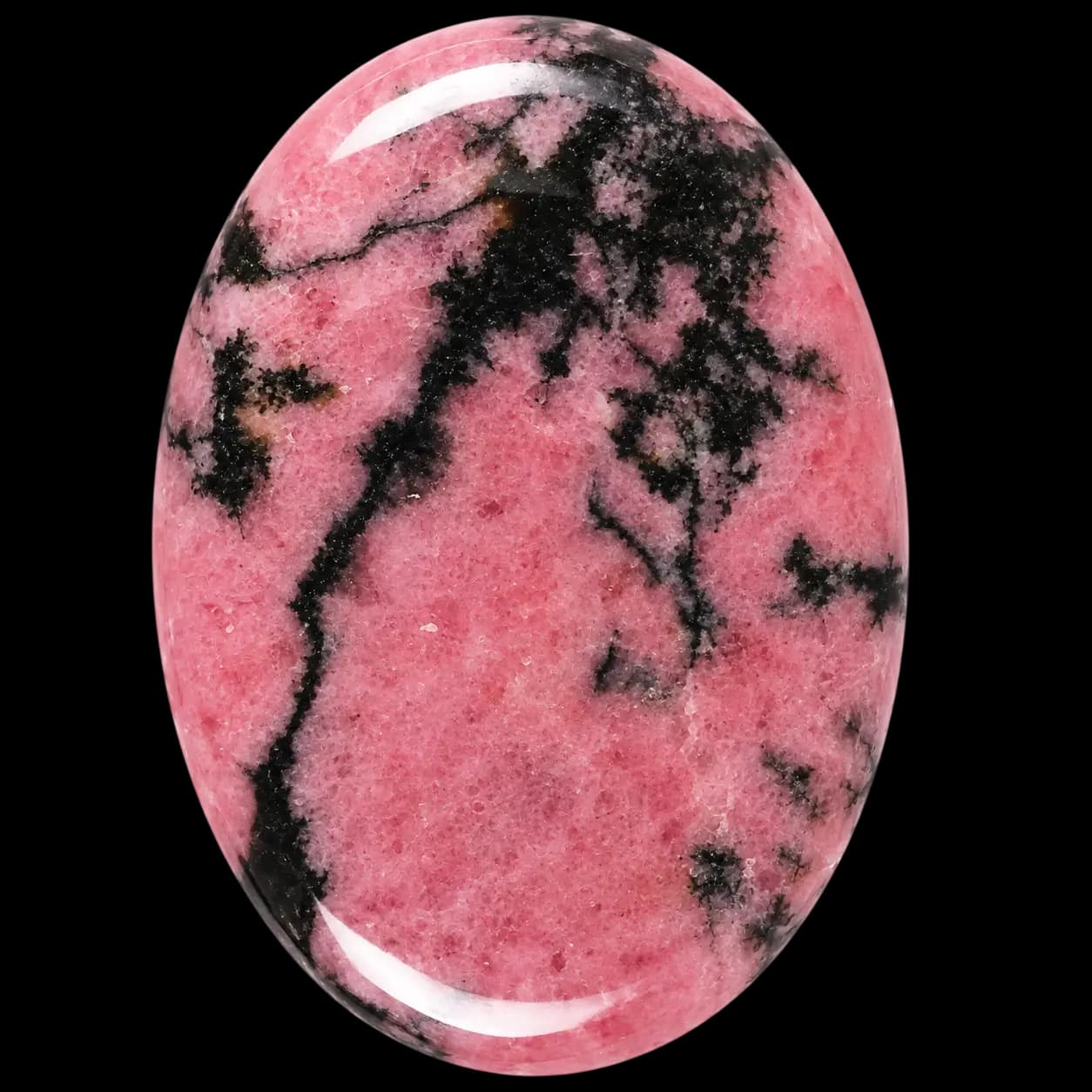
Rhodonite
Rhodonite is a distinctive pink gemstone admired for its rose-red hues, black manganese patterns, and artistic appeal in natural gemstone jewelry.
Rhodonite is a manganese silicate mineral belonging to the pyroxenoid group. Its name comes from the Greek word “rhodon,” meaning rose, referring to its characteristic pink to rose-red colors. It was officially named in 1819 and has since become valued as both a gemstone and an ornamental material.
Rhodonite forms in metamorphic environments where manganese-rich minerals undergo geological transformation. Its chemical composition is generally represented as (Mn,Fe,Mg,Ca)SiO3, with manganese responsible for its attractive pink and red tones. It crystallizes in the triclinic crystal system and commonly occurs as compact masses rather than well-formed crystals.
The most recognizable feature of Rhodonite is its combination of pink, rose-red, and black patterns caused by manganese oxide inclusions. Some specimens display attractive veining, banding, or landscape-like patterns that make each stone visually unique. Transparent crystals are uncommon, while most gem-quality material is cut into cabochons, beads, carvings, and decorative jewelry pieces.
Important sources of Rhodonite include Russia, Australia, Madagascar, Japan, Sweden, Finland, South Africa, Canada, and the United States. Historic Russian deposits produced some of the most famous ornamental Rhodonite, including large decorative works displayed in museums.
Today, Rhodonite jewelry is appreciated by collectors and designers for its natural patterns and warm pink appearance. It is commonly used in rings, pendants, bracelets, earrings, and artistic gemstone carvings. Buyers value natural Rhodonite for its individuality, affordability, and distinctive character compared with more common pink gemstones.
- Mineral Family
- Pyroxenoid
- Chemical Formula
- (Mn,Fe,Mg,Ca)SiO3
- Mohs Hardness
- 5.5 - 6.5
- Refractive Index
- 1.71 - 1.75
- Specific Gravity
- 3.40 - 3.70
- Cleavage
- Perfect
- Crystal System
- Triclinic
- Luster
- Greasy
- Color Range
- Pink, Red, Black
When buying Rhodonite gemstone, several factors influence quality and value.
Color: Rich rose-pink to red shades are generally preferred. Stones with attractive contrast between pink areas and dark manganese patterns are especially popular among collectors.
Clarity: Most Rhodonite is opaque or translucent. Instead of traditional gemstone clarity, buyers often focus on the beauty, balance, and uniqueness of its natural patterns.
Cut: Rhodonite is commonly shaped into cabochons, beads, and carvings because these forms highlight its colors and patterns. A skilled polish can enhance its natural luster.
Carat: Larger pieces are available because Rhodonite often occurs in massive formations. Size can increase value when combined with attractive color and pattern quality.
Origin: Certain origins, especially historically significant Russian material, may be valued by collectors. However, appearance and craftsmanship are usually more important price factors.
Treatments: Natural Rhodonite is generally valued when its original color and patterns are preserved. Some commercial material may be dyed or enhanced, so buyers should ask about treatments before purchase.
Natural vs lab-grown: Natural Rhodonite is widely available, while synthetic Rhodonite is uncommon in the gemstone market. Confirming natural origin and disclosure of any treatments is important.
Certification: For valuable pieces, a gemstone report from a recognized gemological laboratory can help verify identity and any treatments. When you buy Rhodonite online, choose sellers who provide transparent descriptions and authenticity information.
Rhodonite jewelry should be handled with care because its moderate hardness makes it vulnerable to scratches from harder materials.
Cleaning: Use warm water, mild soap, and a soft cloth or brush for gentle cleaning. Rinse well and dry with a soft cloth.
Storage: Store Rhodonite separately from harder gemstones such as diamonds and sapphires to avoid surface scratches. A fabric-lined jewelry box or soft pouch is recommended.
Everyday wear: Rhodonite rings and bracelets are suitable for occasional or careful daily wear, but they should be removed during activities involving impact, heavy work, or harsh chemicals.
Avoid: Do not expose Rhodonite to strong acids, abrasive cleaners, ultrasonic cleaners, or sudden temperature changes, as these may affect the stone's appearance.
Rhodonite is a manganese silicate mineral belonging to the pyroxenoid group. Its name comes from the Greek word “rhodon,” meaning rose, referring to its characteristic pink to rose-red colors. It was officially named in 1819 and has since become valued as both a gemstone and an ornamental material.
Rhodonite forms in metamorphic environments where manganese-rich minerals undergo geological transformation. Its chemical composition is generally represented as (Mn,Fe,Mg,Ca)SiO3, with manganese responsible for its attractive pink and red tones. It crystallizes in the triclinic crystal system and commonly occurs as compact masses rather than well-formed crystals.
The most recognizable feature of Rhodonite is its combination of pink, rose-red, and black patterns caused by manganese oxide inclusions. Some specimens display attractive veining, banding, or landscape-like patterns that make each stone visually unique. Transparent crystals are uncommon, while most gem-quality material is cut into cabochons, beads, carvings, and decorative jewelry pieces.
Important sources of Rhodonite include Russia, Australia, Madagascar, Japan, Sweden, Finland, South Africa, Canada, and the United States. Historic Russian deposits produced some of the most famous ornamental Rhodonite, including large decorative works displayed in museums.
Today, Rhodonite jewelry is appreciated by collectors and designers for its natural patterns and warm pink appearance. It is commonly used in rings, pendants, bracelets, earrings, and artistic gemstone carvings. Buyers value natural Rhodonite for its individuality, affordability, and distinctive character compared with more common pink gemstones.
- Mineral Family
- Pyroxenoid
- Chemical Formula
- (Mn,Fe,Mg,Ca)SiO3
- Mohs Hardness
- 5.5 - 6.5
- Refractive Index
- 1.71 - 1.75
- Specific Gravity
- 3.40 - 3.70
- Cleavage
- Perfect
- Crystal System
- Triclinic
- Luster
- Greasy
- Color Range
- Pink, Red, Black
When buying Rhodonite gemstone, several factors influence quality and value.
Color: Rich rose-pink to red shades are generally preferred. Stones with attractive contrast between pink areas and dark manganese patterns are especially popular among collectors.
Clarity: Most Rhodonite is opaque or translucent. Instead of traditional gemstone clarity, buyers often focus on the beauty, balance, and uniqueness of its natural patterns.
Cut: Rhodonite is commonly shaped into cabochons, beads, and carvings because these forms highlight its colors and patterns. A skilled polish can enhance its natural luster.
Carat: Larger pieces are available because Rhodonite often occurs in massive formations. Size can increase value when combined with attractive color and pattern quality.
Origin: Certain origins, especially historically significant Russian material, may be valued by collectors. However, appearance and craftsmanship are usually more important price factors.
Treatments: Natural Rhodonite is generally valued when its original color and patterns are preserved. Some commercial material may be dyed or enhanced, so buyers should ask about treatments before purchase.
Natural vs lab-grown: Natural Rhodonite is widely available, while synthetic Rhodonite is uncommon in the gemstone market. Confirming natural origin and disclosure of any treatments is important.
Certification: For valuable pieces, a gemstone report from a recognized gemological laboratory can help verify identity and any treatments. When you buy Rhodonite online, choose sellers who provide transparent descriptions and authenticity information.
Rhodonite jewelry should be handled with care because its moderate hardness makes it vulnerable to scratches from harder materials.
Cleaning: Use warm water, mild soap, and a soft cloth or brush for gentle cleaning. Rinse well and dry with a soft cloth.
Storage: Store Rhodonite separately from harder gemstones such as diamonds and sapphires to avoid surface scratches. A fabric-lined jewelry box or soft pouch is recommended.
Everyday wear: Rhodonite rings and bracelets are suitable for occasional or careful daily wear, but they should be removed during activities involving impact, heavy work, or harsh chemicals.
Avoid: Do not expose Rhodonite to strong acids, abrasive cleaners, ultrasonic cleaners, or sudden temperature changes, as these may affect the stone's appearance.
Rhodonite for Sale
No gems found
Try broadening your search or adjusting your filters.
Have a gem of your own? List it free - no fees