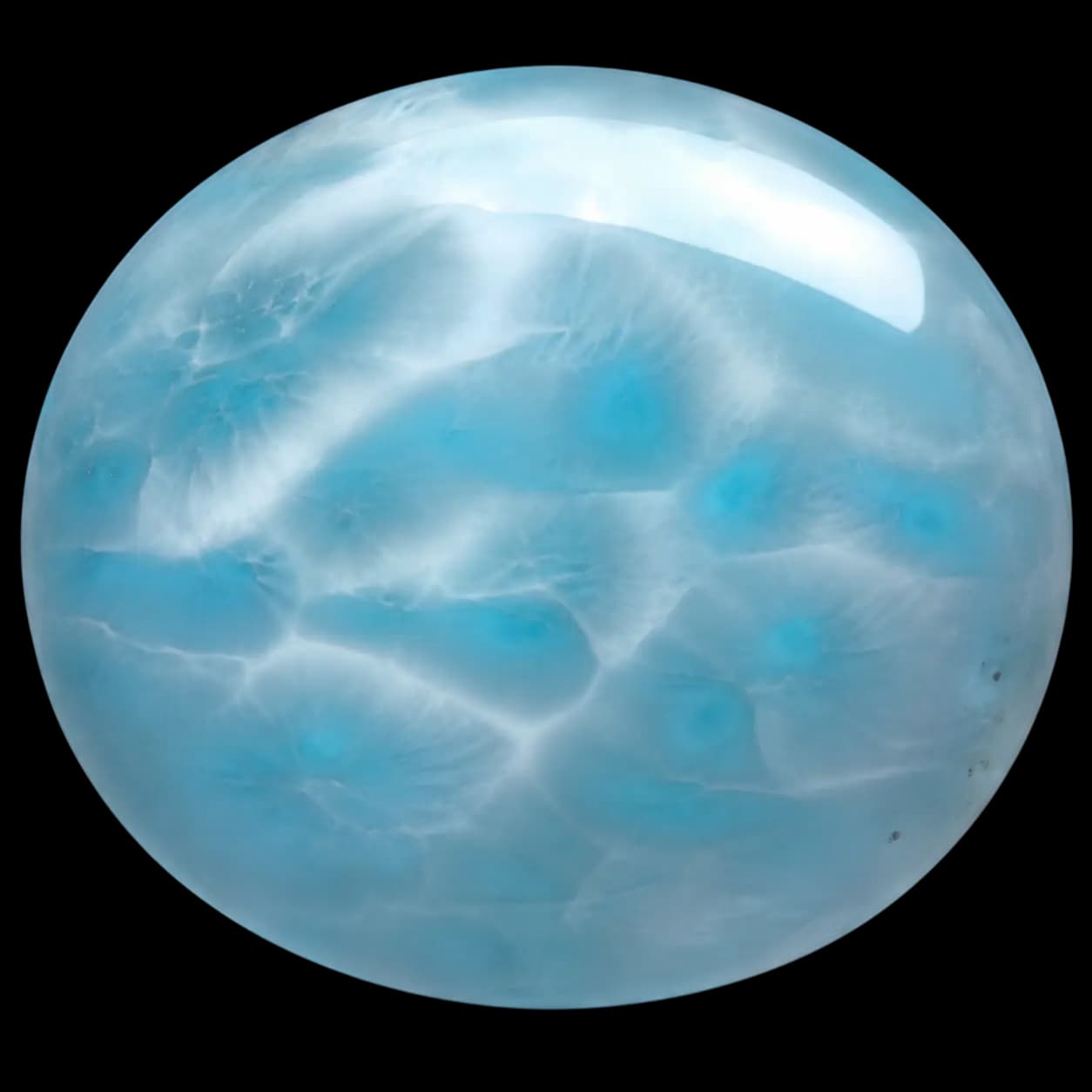
Larimar
Larimar is a rare blue gemstone from the Dominican Republic, admired for its ocean-inspired colors, unique patterns, and elegant appeal in jewelry.
Larimar is a rare variety of the mineral pectolite, recognized for its distinctive blue shades and cloud-like white patterns. It belongs to the silicate mineral family and is known for its unique appearance rather than traditional crystal transparency.
Larimar forms in volcanic environments where mineral-rich fluids interact with cavities in volcanic rocks. The blue coloration is caused by copper substitution within the mineral structure, creating shades ranging from pale blue and turquoise to deeper ocean-blue tones.
With a chemical composition of NaCa2Si3O8(OH), Larimar has a triclinic crystal system, vitreous to pearly luster, and a Mohs hardness of approximately 4.5 to 5. It is typically opaque to translucent and is most commonly cut as cabochons to highlight its natural patterns.
The gemstone is found almost exclusively in the Barahona region of the Dominican Republic, making it one of the most geographically limited gemstones available. Its discovery in the 20th century and its Caribbean origin have contributed to its popularity among collectors and jewelry enthusiasts worldwide.
Larimar gemstone is valued for its soft blue colors, natural wave-like patterns, and individuality. Since every stone has different markings, Larimar jewelry pieces often have a one-of-a-kind appearance. It is commonly used in rings, pendants, earrings, bracelets, and decorative gemstone collections.
- Mineral Family
- Pectolite
- Chemical Formula
- NaCa2Si3O8(OH)
- Mohs Hardness
- 4.5 - 5
- Refractive Index
- 1.59 - 1.63
- Specific Gravity
- 2.70 - 2.90
- Cleavage
- Perfect cleavage in one direction
- Crystal System
- Triclinic
- Luster
- Pearly
- Color Range
- Blue, Cyan, White
When you buy Larimar online, quality depends on several important factors including color, pattern, size, craftsmanship, and authenticity.
Color: The most desirable Larimar gemstones display rich blue or cyan tones with attractive white patterns resembling ocean waves or clouds. Deeper and more evenly distributed blue colors are generally considered more valuable than pale or grayish material.
Clarity: Larimar is usually opaque, so traditional gemstone clarity is less important. Buyers should look for stones with smooth surfaces, attractive natural patterns, and minimal cracks or rough areas.
Cut: Most Larimar is shaped into cabochons because this style enhances the gemstone’s natural patterns and color. A quality cut should have good polish, balanced proportions, and a smooth finish.
Carat: Larger Larimar pieces with attractive colors and patterns are often more valuable. However, overall appearance and quality are more important than size alone.
Origin: Genuine Larimar comes from the Dominican Republic. Since it has a very limited mining location, origin information is an important part of authenticity.
Treatments: Most Larimar is sold in its natural state after cutting and polishing. Some lower-quality material may be stabilized to improve durability. Buyers should always ask about any treatments before purchasing.
Natural vs Lab-Grown: Natural Larimar is valued because of its rarity and unique formation. Synthetic Larimar is not commonly available in the gemstone market, but buyers should purchase from trusted sellers who provide accurate descriptions.
Certification: For valuable Larimar pieces, request authenticity documentation that confirms gemstone identity, origin details, and any treatments.
Price Factors: Larimar prices are influenced by color intensity, pattern quality, size, origin, craftsmanship, and overall rarity. Premium pieces with vibrant blue colors and attractive natural patterns command higher prices.
Larimar jewelry requires gentle care because of its moderate hardness. Clean your Larimar gemstone with a soft cloth, mild soap, and lukewarm water. Avoid harsh chemicals, steam cleaning, and ultrasonic cleaners, which may damage the stone.
Store Larimar jewelry separately from harder gemstones such as diamonds or sapphires to prevent scratches. Keep pieces in a soft pouch or lined jewelry box when not in use.
Larimar is suitable for occasional and careful everyday wear, especially in pendants and earrings. Rings should be worn with extra attention because the stone can be scratched or chipped by impacts. Avoid prolonged exposure to strong sunlight, extreme heat, and abrasive surfaces.
Larimar is a rare variety of the mineral pectolite, recognized for its distinctive blue shades and cloud-like white patterns. It belongs to the silicate mineral family and is known for its unique appearance rather than traditional crystal transparency.
Larimar forms in volcanic environments where mineral-rich fluids interact with cavities in volcanic rocks. The blue coloration is caused by copper substitution within the mineral structure, creating shades ranging from pale blue and turquoise to deeper ocean-blue tones.
With a chemical composition of NaCa2Si3O8(OH), Larimar has a triclinic crystal system, vitreous to pearly luster, and a Mohs hardness of approximately 4.5 to 5. It is typically opaque to translucent and is most commonly cut as cabochons to highlight its natural patterns.
The gemstone is found almost exclusively in the Barahona region of the Dominican Republic, making it one of the most geographically limited gemstones available. Its discovery in the 20th century and its Caribbean origin have contributed to its popularity among collectors and jewelry enthusiasts worldwide.
Larimar gemstone is valued for its soft blue colors, natural wave-like patterns, and individuality. Since every stone has different markings, Larimar jewelry pieces often have a one-of-a-kind appearance. It is commonly used in rings, pendants, earrings, bracelets, and decorative gemstone collections.
- Mineral Family
- Pectolite
- Chemical Formula
- NaCa2Si3O8(OH)
- Mohs Hardness
- 4.5 - 5
- Refractive Index
- 1.59 - 1.63
- Specific Gravity
- 2.70 - 2.90
- Cleavage
- Perfect cleavage in one direction
- Crystal System
- Triclinic
- Luster
- Pearly
- Color Range
- Blue, Cyan, White
When you buy Larimar online, quality depends on several important factors including color, pattern, size, craftsmanship, and authenticity.
Color: The most desirable Larimar gemstones display rich blue or cyan tones with attractive white patterns resembling ocean waves or clouds. Deeper and more evenly distributed blue colors are generally considered more valuable than pale or grayish material.
Clarity: Larimar is usually opaque, so traditional gemstone clarity is less important. Buyers should look for stones with smooth surfaces, attractive natural patterns, and minimal cracks or rough areas.
Cut: Most Larimar is shaped into cabochons because this style enhances the gemstone’s natural patterns and color. A quality cut should have good polish, balanced proportions, and a smooth finish.
Carat: Larger Larimar pieces with attractive colors and patterns are often more valuable. However, overall appearance and quality are more important than size alone.
Origin: Genuine Larimar comes from the Dominican Republic. Since it has a very limited mining location, origin information is an important part of authenticity.
Treatments: Most Larimar is sold in its natural state after cutting and polishing. Some lower-quality material may be stabilized to improve durability. Buyers should always ask about any treatments before purchasing.
Natural vs Lab-Grown: Natural Larimar is valued because of its rarity and unique formation. Synthetic Larimar is not commonly available in the gemstone market, but buyers should purchase from trusted sellers who provide accurate descriptions.
Certification: For valuable Larimar pieces, request authenticity documentation that confirms gemstone identity, origin details, and any treatments.
Price Factors: Larimar prices are influenced by color intensity, pattern quality, size, origin, craftsmanship, and overall rarity. Premium pieces with vibrant blue colors and attractive natural patterns command higher prices.
Larimar jewelry requires gentle care because of its moderate hardness. Clean your Larimar gemstone with a soft cloth, mild soap, and lukewarm water. Avoid harsh chemicals, steam cleaning, and ultrasonic cleaners, which may damage the stone.
Store Larimar jewelry separately from harder gemstones such as diamonds or sapphires to prevent scratches. Keep pieces in a soft pouch or lined jewelry box when not in use.
Larimar is suitable for occasional and careful everyday wear, especially in pendants and earrings. Rings should be worn with extra attention because the stone can be scratched or chipped by impacts. Avoid prolonged exposure to strong sunlight, extreme heat, and abrasive surfaces.
Larimar for Sale
No gems found
Try broadening your search or adjusting your filters.
Have a gem of your own? List it free - no fees