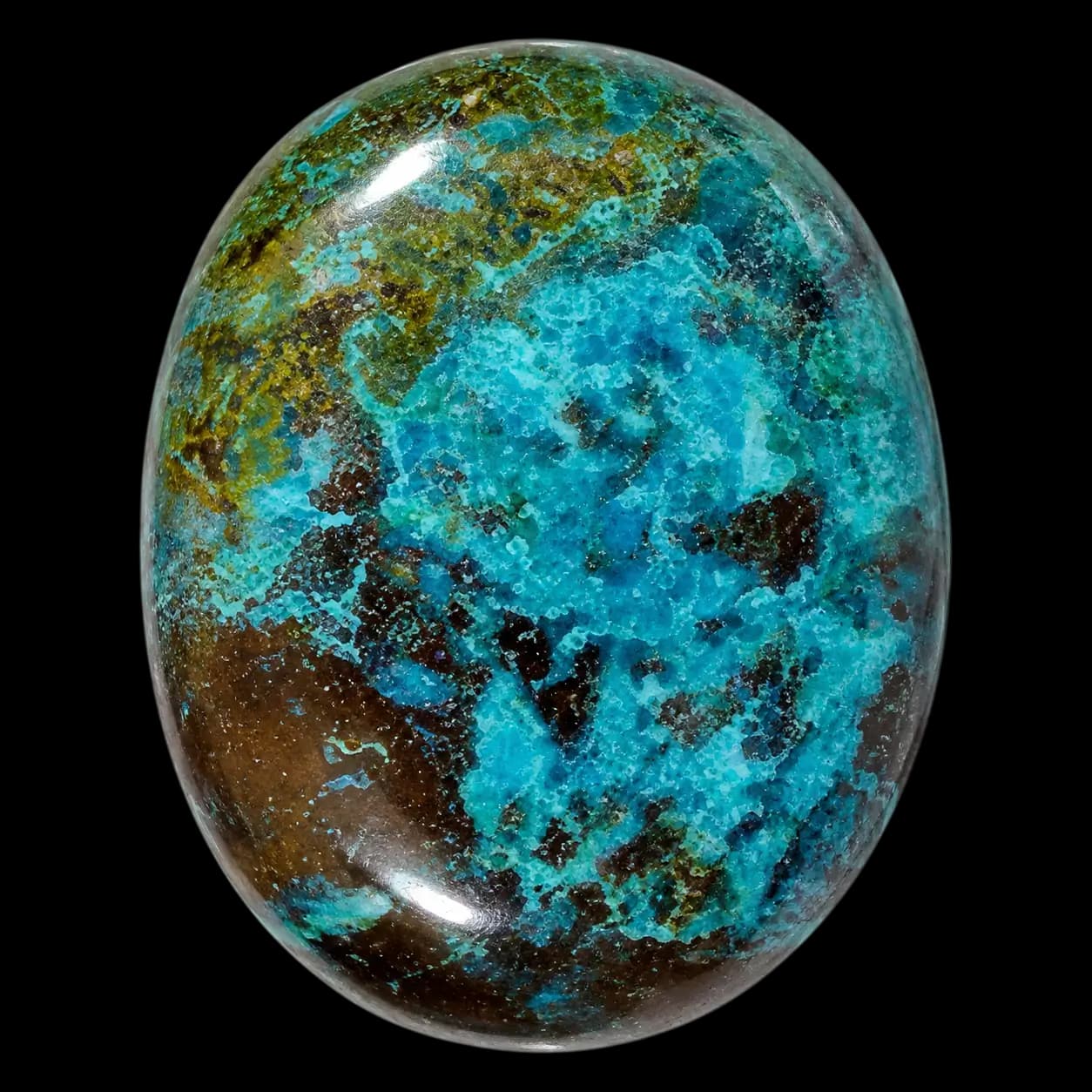
Chrysocolla
Natural Chrysocolla is admired for its captivating blue-green colors, distinctive copper-rich patterns, and artistic appearance. Its unique beauty makes it a sought-after gemstone for collectors and statement jewelry.
Chrysocolla is a beautiful copper-rich gemstone celebrated for its striking shades of blue, cyan, and green that resemble tropical seas and natural landscapes. Although commonly referred to as a mineral, chrysocolla often occurs as an amorphous or microcrystalline hydrated copper silicate and is frequently found alongside quartz, malachite, azurite, turquoise, and cuprite.
It forms in the oxidation zones of copper deposits where copper-bearing minerals slowly react with groundwater over long geological periods. This natural process creates intricate patterns, swirls, and matrix designs, making every stone unique.
Because of its relatively low hardness of 2.5-3.5 on the Mohs scale, chrysocolla is primarily used in pendants, earrings, brooches, and other jewelry that receives less daily wear. Gem-quality material is often stabilized or naturally intermixed with quartz, producing Gem Silica, an exceptionally durable and highly prized variety.
Major sources include Peru, Chile, the Democratic Republic of the Congo, Israel, Mexico, the United States, and Australia. Arizona's copper mines have produced some of the world's most famous chrysocolla specimens.
Collectors and jewelry enthusiasts value natural Chrysocolla for its vivid color, artistic patterns, rarity in fine quality, and strong association with historic copper mining regions. Every gemstone displays a distinctive combination of colors and natural matrix that cannot be exactly duplicated.
- Mineral Family
- Chrysocolla
- Chemical Formula
- (Cu,Al)2H2Si2O5(OH)4 nH2O
- Mohs Hardness
- 2.5 - 3.5
- Refractive Index
- 1.460 - 1.570
- Specific Gravity
- 2.00 - 2.40
- Cleavage
- None
- Crystal System
- Orthorhombic
- Luster
- Vitreous
- Color Range
- Blue, Green, Cyan
When buying Chrysocolla, color is the most important quality factor. Stones displaying vivid turquoise-blue, cyan, or rich blue-green colors with even saturation are generally the most desirable. Attractive natural matrix patterns can also enhance value.
Since Chrysocolla is usually opaque, clarity refers to surface quality rather than transparency. Choose stones with smooth polishing, minimal fractures, and an even finish.
Cabochon cuts are the most common because they best showcase the gemstone's natural patterns and colors. Well-proportioned freeform and oval cabochons are especially popular for jewelry.
Carat weight influences price, but exceptional color and attractive patterns often have greater impact than size alone.
Peru, Chile, Arizona (USA), and the Democratic Republic of the Congo are among the best-known sources. Origin may interest collectors, although appearance and overall quality remain the primary value factors.
Many Chrysocolla gemstones are stabilized with clear resin to improve durability. This is an accepted treatment when fully disclosed. Quartz-rich Gem Silica is naturally harder and commands significantly higher prices.
Laboratory-grown Chrysocolla is not commercially common, but imitation materials and dyed composites exist. Purchase only from reputable sellers who clearly disclose treatments and provide certification from recognized gemological laboratories whenever available.
Certification helps verify authenticity, treatments, and gemstone identity, giving buyers greater confidence when purchasing natural Chrysocolla online.
Because Chrysocolla is relatively soft, it requires gentle handling. Clean it using lukewarm water, mild soap, and a soft cloth or soft brush. Rinse thoroughly and dry immediately.
Avoid ultrasonic cleaners, steam cleaners, harsh chemicals, acids, bleach, and abrasive cleaning products.
Store Chrysocolla separately in a soft pouch or jewelry box to prevent scratches from harder gemstones such as sapphire, ruby, quartz, or diamond.
For rings and bracelets, avoid heavy impacts and remove jewelry before sports, gardening, household cleaning, or other activities that may damage the stone. With proper care, natural Chrysocolla jewelry can retain its beauty for many years.
Chrysocolla is a beautiful copper-rich gemstone celebrated for its striking shades of blue, cyan, and green that resemble tropical seas and natural landscapes. Although commonly referred to as a mineral, chrysocolla often occurs as an amorphous or microcrystalline hydrated copper silicate and is frequently found alongside quartz, malachite, azurite, turquoise, and cuprite.
It forms in the oxidation zones of copper deposits where copper-bearing minerals slowly react with groundwater over long geological periods. This natural process creates intricate patterns, swirls, and matrix designs, making every stone unique.
Because of its relatively low hardness of 2.5-3.5 on the Mohs scale, chrysocolla is primarily used in pendants, earrings, brooches, and other jewelry that receives less daily wear. Gem-quality material is often stabilized or naturally intermixed with quartz, producing Gem Silica, an exceptionally durable and highly prized variety.
Major sources include Peru, Chile, the Democratic Republic of the Congo, Israel, Mexico, the United States, and Australia. Arizona's copper mines have produced some of the world's most famous chrysocolla specimens.
Collectors and jewelry enthusiasts value natural Chrysocolla for its vivid color, artistic patterns, rarity in fine quality, and strong association with historic copper mining regions. Every gemstone displays a distinctive combination of colors and natural matrix that cannot be exactly duplicated.
- Mineral Family
- Chrysocolla
- Chemical Formula
- (Cu,Al)2H2Si2O5(OH)4 nH2O
- Mohs Hardness
- 2.5 - 3.5
- Refractive Index
- 1.460 - 1.570
- Specific Gravity
- 2.00 - 2.40
- Cleavage
- None
- Crystal System
- Orthorhombic
- Luster
- Vitreous
- Color Range
- Blue, Green, Cyan
When buying Chrysocolla, color is the most important quality factor. Stones displaying vivid turquoise-blue, cyan, or rich blue-green colors with even saturation are generally the most desirable. Attractive natural matrix patterns can also enhance value.
Since Chrysocolla is usually opaque, clarity refers to surface quality rather than transparency. Choose stones with smooth polishing, minimal fractures, and an even finish.
Cabochon cuts are the most common because they best showcase the gemstone's natural patterns and colors. Well-proportioned freeform and oval cabochons are especially popular for jewelry.
Carat weight influences price, but exceptional color and attractive patterns often have greater impact than size alone.
Peru, Chile, Arizona (USA), and the Democratic Republic of the Congo are among the best-known sources. Origin may interest collectors, although appearance and overall quality remain the primary value factors.
Many Chrysocolla gemstones are stabilized with clear resin to improve durability. This is an accepted treatment when fully disclosed. Quartz-rich Gem Silica is naturally harder and commands significantly higher prices.
Laboratory-grown Chrysocolla is not commercially common, but imitation materials and dyed composites exist. Purchase only from reputable sellers who clearly disclose treatments and provide certification from recognized gemological laboratories whenever available.
Certification helps verify authenticity, treatments, and gemstone identity, giving buyers greater confidence when purchasing natural Chrysocolla online.
Because Chrysocolla is relatively soft, it requires gentle handling. Clean it using lukewarm water, mild soap, and a soft cloth or soft brush. Rinse thoroughly and dry immediately.
Avoid ultrasonic cleaners, steam cleaners, harsh chemicals, acids, bleach, and abrasive cleaning products.
Store Chrysocolla separately in a soft pouch or jewelry box to prevent scratches from harder gemstones such as sapphire, ruby, quartz, or diamond.
For rings and bracelets, avoid heavy impacts and remove jewelry before sports, gardening, household cleaning, or other activities that may damage the stone. With proper care, natural Chrysocolla jewelry can retain its beauty for many years.
Chrysocolla for Sale
No gems found
Try broadening your search or adjusting your filters.
Have a gem of your own? List it free - no fees